How to write 老
Animated Stroke Order of 老
Learn to write the Chinese character "老" by watching the stroke order animation of "老".
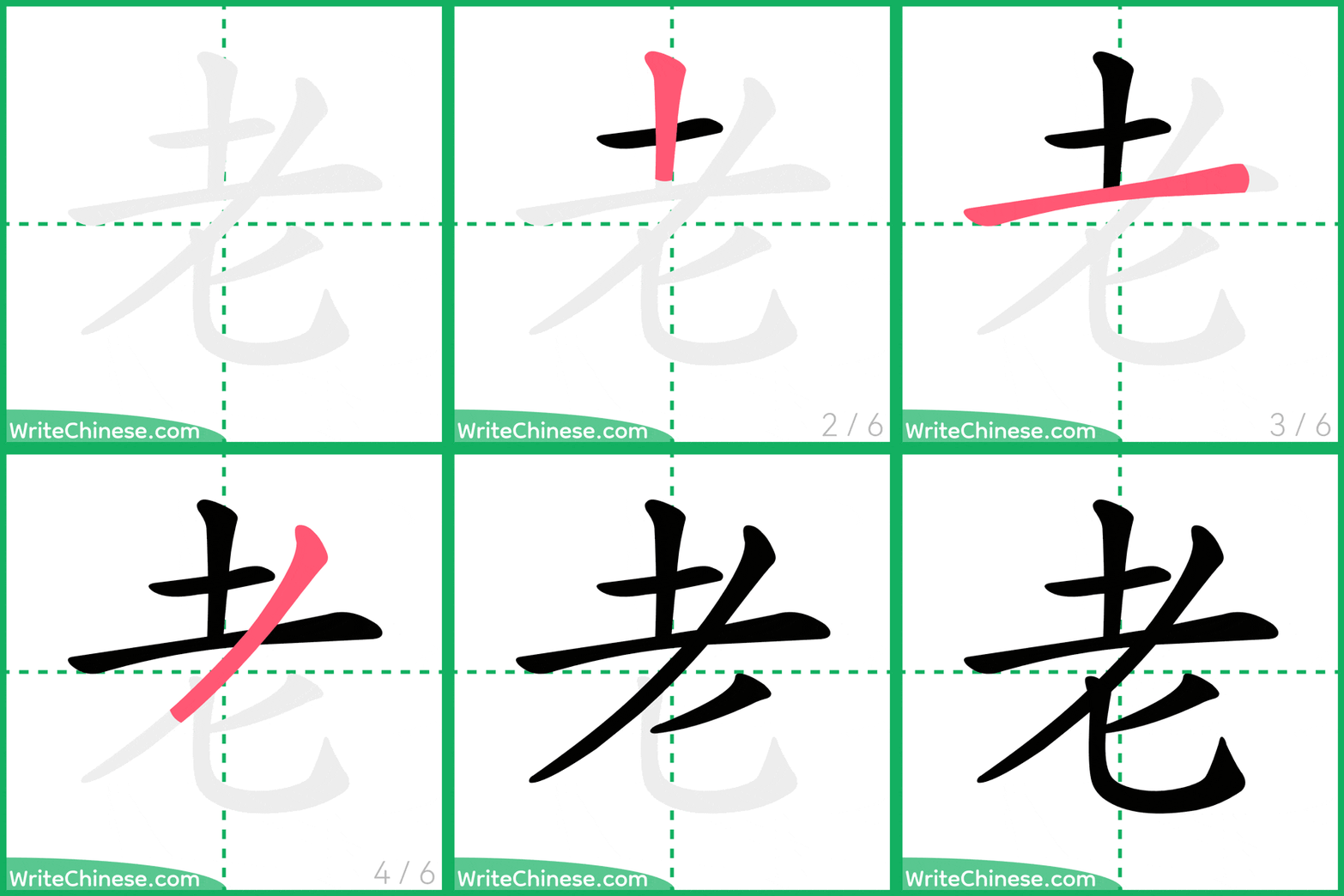
Stroke by Stroke: 老 Writing Order
Master the Chinese character '老' stroke by stroke with visual step-by-step instructions.
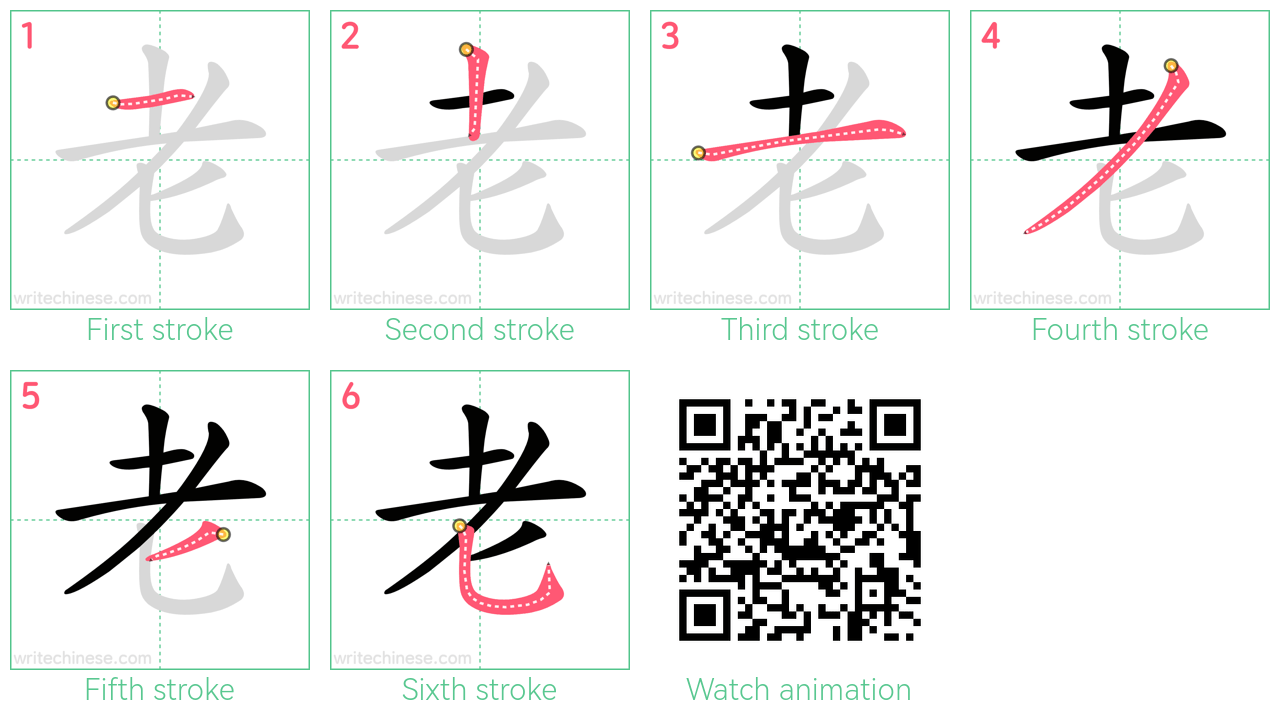
Follow the Calligraphy Master: Writing '老' Step-by-Step
Learn the proper way to write the Chinese character '老' through a video tutorial with a calligraphy teacher. Follow the Calligraphy Master's Step-by-Step Guide to Write the Chinese Character '老'. You can download the printable handwriting worksheets below and practice writing together with pen and paper.
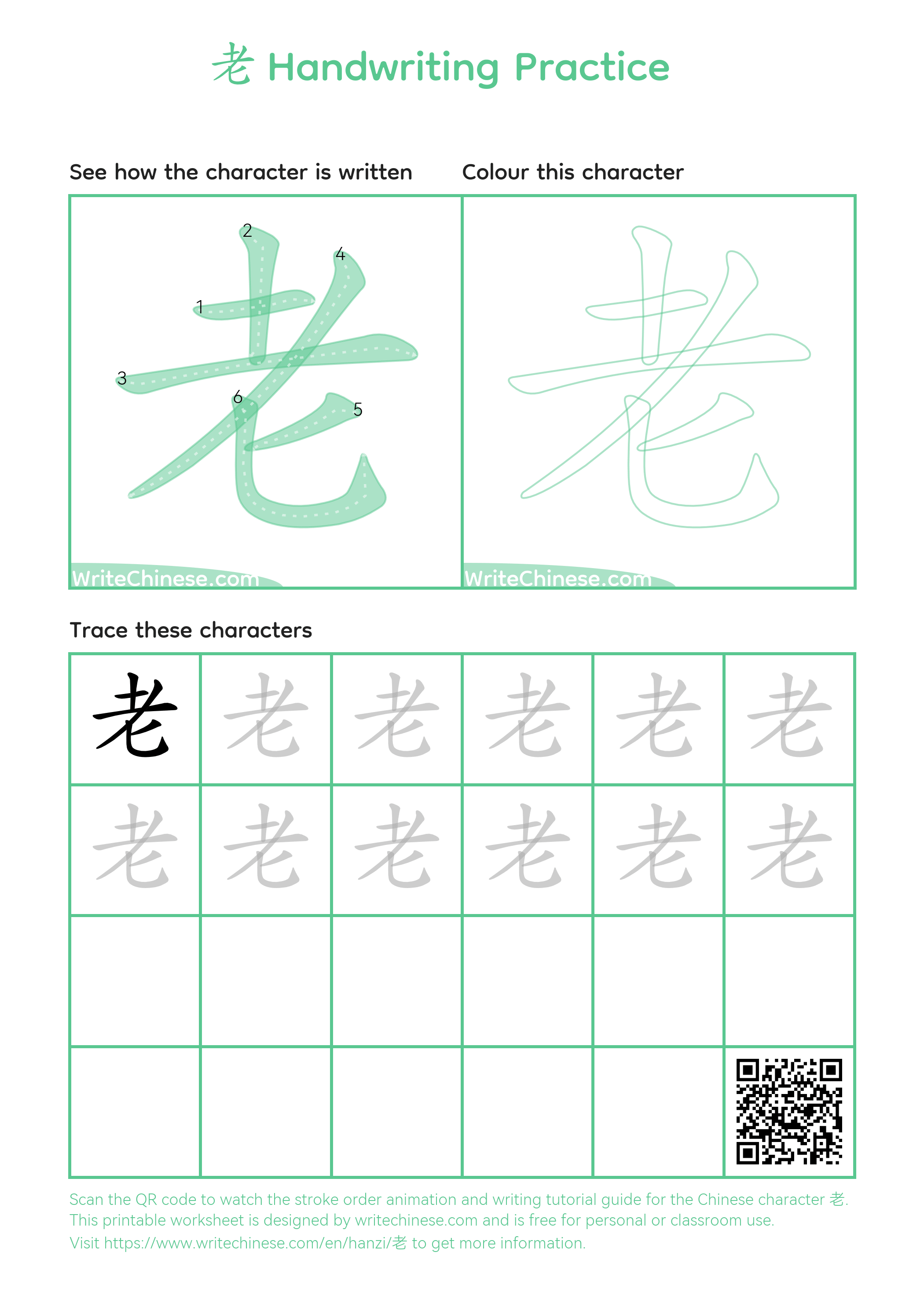
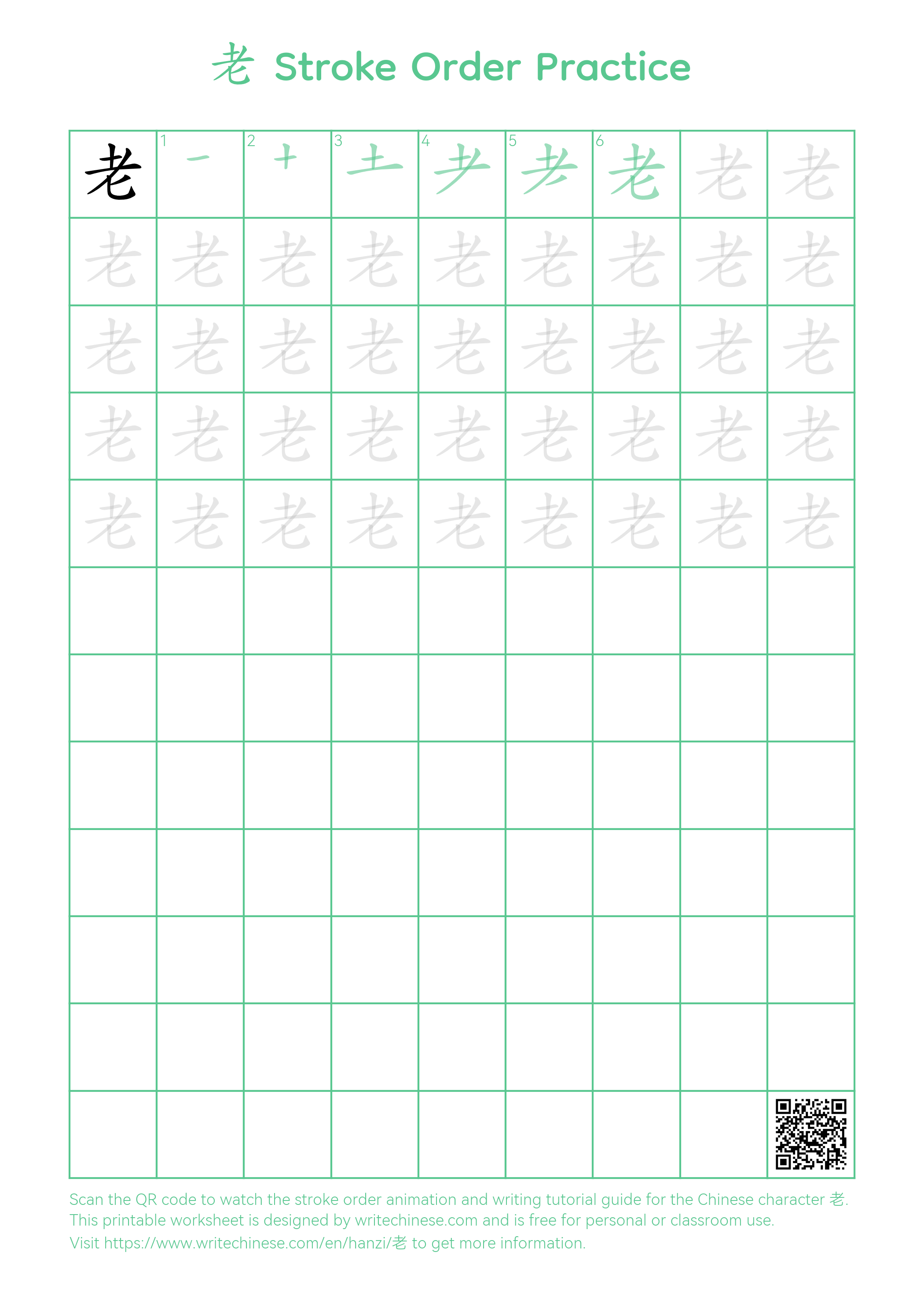
Free Printable 老 Handwriting Practice Worksheets
Meaning of 老
Pinyin
lǎo
Radical
耂
Strokes
6
Definition
(a prefix used before the surname of a person or a numeral indicating the order of birth of the children in a family to indicate affection or familiarity) / old (of people)
Usage
★★★★★
老 [lǎo]
1. 年纪大,时间长,有经验,陈旧的:Old; aged; experienced; long-standing; antiquated.
2. 对年纪大的人的尊称:Honorific term for elderly people.
3. 极,很:Very; extremely.
4. 老年人:Old people; the aged.
5. 晚年:Old age; late years.
6. 敬老,养老:Respecting the elderly; caring for the elderly.
7. 总是,经常:Always; frequently.
8. 原来的:Original; former.
9. 与“嫩”相对:Opposite of tender; mature.
10. 词头,用于表排行,用于表相互尊称,或加在某些动植物名前构成多音节词:Prefix used in naming order, mutual respect, or to form multi-syllabic words with certain plants and animals.
11. 老子(中国先秦思想家)及其学说的简称:Abbreviation for Laozi (Chinese pre-Qin thinker) and his philosophy.
12. 死的讳称:Euphemism for death.
13. 指业主或企业的经营者:Refers to the owner or operator of a business.
14. 姓:Surname.
1. 年纪大,时间长,有经验,陈旧的:Old; aged; experienced; long-standing; antiquated.
例:~当益壮 (The older one is, the stronger one becomes.)。
2. 对年纪大的人的尊称:Honorific for the elderly: 吴 ~ (Mr. Wu, referring to an elder).
3. 极,很:Very; extremely: ~早 (very early)。
4. 老年人:Respect for the elderly: 敬 ~ 院 (nursing home)。
5. 晚年:Old age; late years: ~ 年 (old age)。
6. 敬老,养老:Respecting the elderly: “~吾老,以及人之老。” (Respect my elders and those of others)。
7. 总是,经常:Always; frequently: ~ 是生病 (always sick)。
8. 原来的:Original: ~ 地方 (original place)。
9. 与“嫩”相对:Opposite of tender: 黄瓜长 ~ 了 (The cucumber has matured)。
10. 词头,用于表排行,用于相互尊称:~ 大 (elder brother)。
11. 老子及其学说的简称:Referring to Laozi and his teachings。
12. 死的讳称:Euphemism for death: ~ 了 (passed away)。
13. 指业主或企业的经营者:Owner or operator of a business。
14. 姓:Surname.
形 [lǎo]
本义:年老,衰老: Old; aged.
造字法:会意。甲骨文字形,象一个手里拿着拐杖的老人形: Originally a pictograph representing an old person with a cane.
1. 五十至七十岁的高龄(Old; aged): Referring to old age between fifty and seventy.
2. 历时长久(Long-standing): Refers to a long duration.
3. 娴熟,富有经验,阅历深(Experienced): Referring to deep experience and skill.
4. 厚(Thick): Describes thickness.
5. 大(Great): Refers to greatness.
6. 排行在最后的(Youngest): Referring to being the youngest in rank.
名 [lǎo]
1. 老年;晚年(Old age): Referring to late years.
2. 老年人(Old people; the aged): Referring to elderly individuals.
3. 对先辈、年长者的尊称(Your): Honorific for seniors.
4. 对老人的尊称:Formal address for the elderly.
5. 敬词,多不表示年岁(Respectful term, not indicating age).
6. 自称(I): Self-referring term.
7. 古时对某些臣僚的尊称:Historical term of respect for some officials.
8. 指父母或兄长(Parents or brother).
9. 老子及其哲学的省称(Laozi): An abbreviated reference to Laozi.
10. 姓(Surname): Used as a family name.
动 [lǎo]
1. 死的讳称(Die): Euphemistic expression for death.
2. 敬爱,敬重(Respect and love; honor).
3. 告老(Retire from age): Referring to retirement due to age.
4. 变老;衰老(Be old and feeble): Indicates aging.
5. 衰老;衰颓(Old and feeble; senile; decrepit).
副 [lǎo]
1. 用在动词前面,表示某种动作、行为或状态在一段较长时间里一直持续不断发生或时常重复出现,有“经常”、“时常”的意思; 有时“老”和“是”连用,有强调的意味(Always).
2. 用在形容词前面,表示程度深,相当于“很”、“极”(Very).
3. 很久(For a long time).
前缀 [lǎo]
1. 加在姓、名和某些称谓的前面(Prefix before surnames and certain titles).
2. 加在兄弟姐妹排行次序上(Used in sibling order).
3. 加在某些动植物名词前面(Used with certain nouns of plants and animals).
后缀 [lǎo]
代指人(含有轻视意):Used as a suffix to refer to people in a derogatory sense, also written as “佬”. Examples: 庄稼老 (farmer), 外国老 (foreigner).
(coll.) father's father's mother / paternal great-grandmother / respectful form of address for an old woman
lit. old general / commander-in-chief 將帥|将帅, the equivalent of king in Chinese chess / fig. old-timer / veteran
(affectionate form of address for a male who is not very much younger than oneself) my boy / old pal
replace old cadres with younger ones / supersession of the old by the new / succession of the new to the old
(to live together until the) white hairs of old age (idiom); to live to a ripe old age in conjugal bliss / until death do us part
The old man wept bitterly. / Tears coursed down the old man's cheeks. / tears flowing from aged eyes / The old man's face was covered with tears.
father / daddy / "I, your father" (in anger, or out of contempt) / I (used arrogantly or jocularly)
old age / very / eldest child in a family / leader of a group / boss / captain of a boat / leader of a criminal gang
Same Pronunciation Characters
Same Radical Characters
Easier Access

No need to remember the website address or type any Chinese characters. Simply scan the QR code
for easier access to this page. Alternatively, you can quickly access this page by clicking to
copy and paste the URL.
Input Method for 老
Pinyin
lao3
Wubi
ftxb
Cangjie
jkp
Zhengma
bmrr
Four Corner
44712
Unicode
U+8001
Stroke Number Category
HSK Level Category